Author: Jo Ann
of Luv'N Chins
Rescue Chin ... Or Not?
Rescue, according to Webster's Dictionary, is "The act of delivering from danger ... to extricate, free, liberate ... to save".
'Rescue chins', in some instances, can refer to this meaning for what happens to them when they are in a situation of danger or neglect. Another meaning for a rescue chin could easily be "one that is no longer desired by it's owner", for what ever reason, or a chin that is in a situation that needs more than the 'normal' caring for, love and attention. Keep the reason in mind for a particular chin to be considered a 'rescue chin' before you decide to take it and care for it ... this is where the "Or Not" in the title comes into play. There are many definitions of a 'rescue chin', below are only some of them.
Chins that are perfectly healthy become a 'rescue chin' when they are mistreated, neglected, abused and/or are just no longer wanted by the owner. For these chins, there should be no hesitation in taking them in your home and giving them all the love, attention and care you can give them. Most of time this chin will need extra care (this is often costly), love and patients to un-do what has been done to it. Sometimes they will be sold for a minimal amount or even given to you for free, but nothing is really 'free'. This is a win-win situation for both you and the chin. You will care for them, and in turn, you will usually receive an abundance of unrelenting love.
Another type of 'rescue chin' is a female that has been 'bred-out' (or over bred or has had multiple breed-backs) and is no longer physically able to safely carry and take care of a litter of kits, therefore useless to an unscrupulous breeder. Most good breeders will not do this to a female breeder or, should they receive one, will put it in retirement or will find a 'pet only, not to be bred' home. This chin has had the misfortune of belonging to someone that is more interested in money than they are in the chins and the future of all chins. These chins need a 'retirement home' where they can spend the rest of their lives loving and being loved by their human parents that have adopted it. Sometimes, due to breed-back or nerves, due to the stress they have been under, you will often find them irritable, more nervous, under weight, and/or are less healthy due to the situation they were living in. Often, they are not very social, but this can usually be changed with love, patients and time. With lots of loving care and a special attention given to nutrition, they may become a healthy happy chin again, but should never breed again. A possible win-win situation.
When a chin or kit is mistreated or abused by it's siblings and/or parent(s), the damage is often to bad to save it. If it can be saved, it will often be offered as a 'rescue chin', regardless of it's outward appearance, it will usually grow-up to be a healthy happy chin. It might be disfigured, but that does not affect it's ability to love and be loved. The fact that the chin may be disfigured, due to the fact it was due to an accident or fight and not from nature, it can even be put into breeding, should you want to do so. Another win-win situation.
Sometimes kits, for no apparent reason, can be born with some outward physical defects, this is often another form of a rescue chin. Again, this does not keep it from living and loving. In these situations it should not be considered for breeding, the 'defect' could be hereditary. Normally, a good breeder will take the parents out of breeding after giving them a second chance to see if this will be the 'norm' or if it was just a freak accident of nature. Some breeders will not take the 'second chance' and take the parents out of breeding or match them up with other breeding partners. Should you have a pair of chins that produce a 'defective' kit, please notify the original owners of the parents and alert them to the possible problem. Breeding chinchillas gives you the obligation to prevent any possible future 'problems' that arise in the best way you can, for the future of all chinchillas. If you can not handle this responsibility, please do not breed.
Pet store chins, according to most good breeders, are almost always considered 'rescue chins', basically for the reason you have no information on the parents, where they come from, or most of the time, not even their exact age. You have no way of knowing if there are physical defects that may be hereditary in their genes. By not knowing the past history, you do not know if they are prone to malocclusion or heart murmurs, both of which can be painful and very deadly for the little chin. For these reasons, they are not normally considered for breeding. Of course, for those of you who have or will purchase a chin from a pet store, you know the price for them is not minimal, discounted and definitely not free. On the contrary, they are usually over priced for the situation. A win-win situation? Not usually, not at all if you are a breeder or want to breed ... you would have a 'pig-in-the-poke' or, to many 'unknown factors' to consider breeding this chin.
A 'fur chewer' is often considered a rescue chin. Fur chewing and the cause of it, is very debatable by most of the chin community. Some think fur chewing is hereditary, others believe it is due to circumstances. Either way, it is considered 'not a desirable' trait in a chinchilla. Also, when a fur chewer is introduced to another chin, the fur chewer may teach your other chin/chins to do the same, chins often learn good and bad habits by watching. Fur chewing can, some believe, cause hairballs, which is not healthy for a chin and has been known to block the intestines. Fur chewing is the sign of a nervous chin, also undesirable. The act of chewing the fur also leaves what was once a beautiful even fur to become ugly with gaps in the height of the fur, allowing it to look quite a mess. Some chins will stop fur chewing when put in a different environment or situation. Sometimes, something as simple as lack of nutrients and/or hay will cause a chin to chew it's fur and can be corrected. Often a chin in a to-small confined area with nothing to do and can become a fur chewer ... the simple act of giving it a larger living area and lots of love, may correct the fur chewing. Loud or sudden noises can cause a chin to become nervous and become a fur chewer. Here you have another possible win-win situation by just changing the situation it was in.
Sometimes a chin that is unusually small, or does not grow in size that is normal for most chins, is considered a rescue chin. Often these little chins will be given or sold as a rescue chin. Here is where you have to be very careful. Usually these chins are premature and/or have an internal defect, or for an unknown reason, will not/has not been able to develop all of it's organs properly or at the normal rate, causing defects in these. This little chin is usually eventually doomed. In chins, as in humans, born prematurely, in most cases, all is not and may not develop properly. If you are not willing to be heart-broken, leave this chin alone. These little chins require much more love and attention and, more often than not, much more costly vet care than normal. The hours required to tend to this little one makes you bond very strongly with this little angel. Your heart will swell with love and affection for this precious fur ball, only to feel as if it is exploding when you, without apparent reason, find it dead, or as you are holding it in it's last few hours or minutes. It takes a special person to love and care for something that they know will, most likely, leave them so prematurely. A win-win situation? Yes, for some, no, for others. These little ones will often die in weeks or months, or, if you are very lucky, it may live to be up to two years old, rather than the possible 20+ years. If, physically or monetarily, you are not able to care properly for this little one ... or if you do not feel you can emotionally handle it's death, please, do not take it home, no matter how cute it may appear to you. If you have the love for them and can handle the heart-break when they leave you, take this little angel home, the reward of what little time you have with it is a precious gift, one you will never forget and will always cherish.
This article is dedicated to those little rescue chins who were once with me or that I still have and to those I will never know.
The first one is Teeny, a female beige kit, (received from a large rancher) who weighed only 88 grams at 8 weeks, we only had her for 4 months before a thin lining in her uterus gave way to her intestines, killing her.
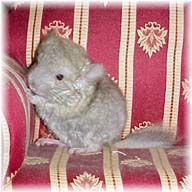
Tiny, a 'miniature' male chin, (also received from a larger rancher) that was with us for a wonderful, but short, year and a half before he died.
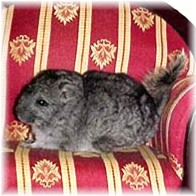
Then, there is Tuffy, a little male standard gray born prematurely, never reaching 32 grams.
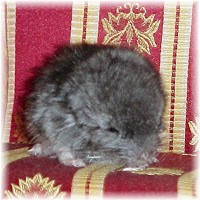
And last, but not least, Sandy and Peaches. Sandy we lost at 4 months of age, Peaches is still with us and is now 7 months old, weighing in at 301 grams ... the normal size of a 2 or 3 month old chin.
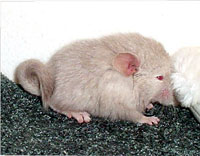
This was our precious Sandy, a female pastel kit.
May each of you that has a chin take care of it, love it, and if necessary, find it a new good home, or return it to the breeder, rather than neglect or abuse it.
Never turn it over to a regular animal shelter, unless they already have a person on file that they
know will know how to care for it. The regular animal shelters usually have no idea how to care for chinchillas,
nor do they have the facilities to do so, it is usually uthanized. For those of you who have a 'rescue chin' by way of an accident or by nature, give it, or find it, a loving home.
|
|
